Active Bystander
Being attacked publicly for who you are is demoralizing and stressful. But being targeted while bystanders do nothing is even worse. It feeds a sense of isolation and empowers the attacker.
We’re fed a myth that most people won’t take action but the truth is we need practice. People who stand up for others often began as children whose parents taught them to. If you didn’t learn to take action, it’s not too late!
How to do it:
First responders train for months or years to manage critical situations calmly and effectively — and they still make mistakes. Most of the rest of us are so frozen by the fear of doing the wrong thing that we do nothing at all, but we can change that! Research says that once one person takes the lead, others join in, so learn to be the person who says “No! That’s not okay!” When someone is being attacked or harassed in a public space, it’s on society to shun the attacker and stand with the victim.
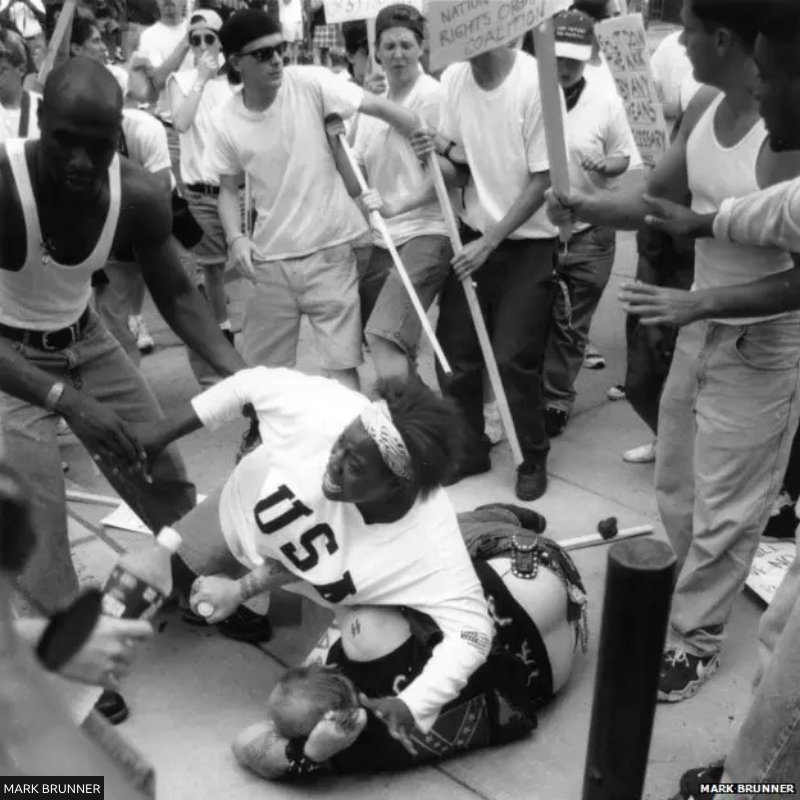
First, identify your moral values. Keshia Thomas, an 18yo Black high school student in Michegan, used her body to protect a man who might well have attacked her in different circumstances. She made a decision about who she was, not who he was. In the moment you won’t know any more about the victim than the people targeting them — so decide now what you’d do, and then practice so you’d do it. By practice, we mean out loud, with friends. Role-play, or join a class. Something you’ve done in a simulated setting will come more naturally in a real one. We’ll offer some starting points at the bottom, but here are the basics:
The “5 D’s” of bystander intervention:
Distract: this is one of the safest interventions. You don’t directly confront the harassment, you redirect attention. If someone is harassing another woman in a bathroom, you might compliment her shoes. It lets the attacker know they don’t have your support while being incongruous enough to put them off-balance. Another example is approaching a woman being harassed as though you know her. “Suzie! OMG is that you Suzie?” and walking off together chatting about your cousin. The key is you don’t acknowledge the harassment at all, and you don’t interact with the harasser. You implicitly ally with the victim and get them out of there.
Delegate: this helps break the inaction barrier. Choose someone in the area and give them a clear assignment to help you change the situation. A common scenario is one person delays the harasser in an entirely unrelated way while the other checks in with the victim. The goal is NOT to directly confront the issue, but to delay or distract the harasser while someone checks in with the victim. Your distraction shouldn’t confront the harassment directly — ask the bartender to serve slowly, or play a confused older tourist looking for directions while one person checks in with the victim.
Document: if others have already taken action, or if you do not feel safe taking direct action, document the interaction. The victim may need evidence later, if charges are brought or if the harasser tries to make themselves the victim. DO NOT SHARE PUBLICLY. Only offer the documentation directly to the victim, or if police become involved give your name and contact information to them. It is the victim’s choice what to do with any footage, images, or details you capture — don’t make things worse!
Delay: even if you can’t or didn’t act in the moment, you can still reduce the isolation the victim may experience by asking them if they need support after the incident. Offer to sit with them until help arrives, or to travel with them to their destination. If you documented the incident write down your contact information, or text them so they can contact you later. Don’t assume they’ll remember what you say.
Direct: directly confronting the harassment is the riskiest option — and the only one most of us think of. You need to start by assessing the situation: direct confrontation may escalate danger for everyone, or it may transfer danger from the current victim to the person intervening. Try to avoid escalating — don’t argue with the person harassing. Use a short, direct statement to disrupt the situation such as “That’s not okay!”, then shift your focus to the victim’s security. Generic statements may be safer and more effective — they don’t give traction for an argument. I once heard a racist statement in a grocery checkout and responded with a startled “No!” in my best dog-training voice. I had a puppy at home, so that’s what I’d practiced lately. It worked.
The most important thing is to make a plan ahead of time, and then practice it. Decide what you are and aren’t comfortable doing. For more ideas and examples, attend one or more intervention trainings. There are dozens designed for different situations here: