Jury nullification
Jury Nullification is a fairly obscure legal response where a jury refuses to convict even though they believe a crime has occurred. A jury can nullify because they think the law is unjust or that punishment will be too harsh. Jury Nullification leverages double-jeopardy, by rendering a not-guilty verdict despite evidence.
How to do it:
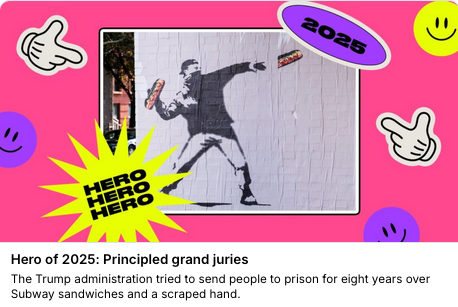
Many of us will be called for jury duty at some point in the coming months and years. We may be asked to do things like indict a man for a crime with penalties up to eight years, for the act of throwing a sandwich at ICE agents. We may conclude that the evidence indicates that he did in fact throw a sandwich, and that this is assault, but we may be morally unwilling to put him on trial for charges that could ruin his life over this. We assume the law will show some common sense.
Today, under Trump, it is instead being used to terrorize. That’s where Jury Nullification comes in: it allows a jury to render a not-guilty verdict even if they believe the defendant broke the law. Learn about jury nullification now, before you’re sitting in a courtroom wishing you had.
Learn More:
The Atlantic : Trump’s Politicized Prosecutions May Hit a Roadblock (Gift Link)
The Fully Informed Jury Association has an explanation and how-to instructions. The most important part is this:
You cannot legally be punished for or required to change your verdict. In fact, there is no requirement for jurors to deliver a verdict. If jurors cannot agree on a verdict, judges may issue additional instructions known as “Allen” or “dynamite” charges. These additional instructions may strongly imply to jurors that they are somehow remiss in their duty if they do not reach a verdict. This is simply not true.
Jurors should not give up their conscientiously held beliefs under such pressure just for the sake of consensus. If they cannot reach a verdict, the judge will at some point declare a mistrial.
Judges and prosecutors may try to conceal this right from you. They may even openly deny that jurors have the ability to do this or falsely suggest that they may be punished for conscientiously acquitting a defendant who has technically broken a law. Appeals courts have ruled that although such instructions are false, they constitute a type of error for which the higher court provides no relief to the defendant. This means that there is no penalty for the government when it falsely instructs jurors on the subject, so it is something we expect to continue for the foreseeable future.